
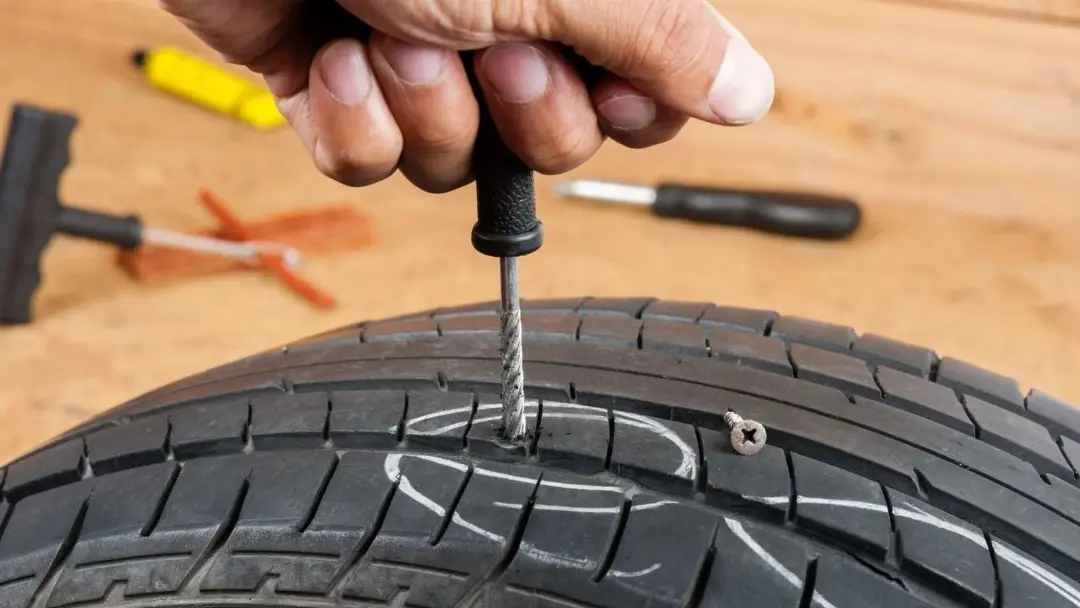
Quick answer: If you have a no spare wheel flat tyre in London, stop somewhere safe, check whether your car has a space-saver, sealant kit or run-flats, and do not keep driving on a soft tyre. Call a mobile fitter for on-site repair or replacement — core ETA is typically 15–30 minutes. Share your postcode, tyre size and whether the pressure warning light is on, then call 07466 610232 (+447466610232).
Open the boot expecting a full-size spare — and find a foam kit, a skinny space-saver, or nothing at all. That moment has become normal across Greater London. Manufacturers save weight and boot space; drivers discover the trade-off only when a nail appears on the North Circular, a kerb clips a sidewall in Wembley, or the tyre pressure warning light flashes on the A40.
Searches for no spare wheel flat tyre London, space saver spare speed limit, tyre sealant kit puncture, mobile tyre fitting no spare and emergency flat tyre London spike every weekday. This guide explains your real options in 2026: what the kit in the boot can and cannot do, when a space-saver is legal and safe, when sealant makes a repair harder, and how a 24/7 mobile tyre van from Tyres & Tyres finishes the job at your pin.
Why so many London cars have no full-size spare
Weight targets, CO₂ figures and larger hybrid / EV battery packs leave less room under the floor. Many modern cars therefore ship with:
- Run-flat tyres — reinforced sidewalls that let you limp a limited distance after pressure loss (see our separate run-flat repair guide).
- A space-saver (temporary spare) — a narrow wheel with strict speed and distance limits.
- A tyre sealant compressor kit — foam or liquid plus a 12V pump for small tread punctures only.
- Nothing — some trims drop the kit entirely and expect roadside assistance or a mobile fitter.
None of those options replace a proper inspection. A sealant can buy you a few miles to a safe car park; it is not a permanent fix. A space-saver is a temporary spare, not a fifth road tyre. And if the tyre is already flat, don’t try to limp on: see how long can you drive on a flat tyre? If you have neither, flat tyre help from a stocked van is the practical answer.
First five minutes: stay safe, then decide
- Get off the live lane. Hazards on, passengers away from traffic where possible. Hard shoulders on motorways are often restricted or unsafe for DIY work — call 999 / National Highways if you cannot reach a safer place.
- Do not keep driving on a soft or flat tyre. Extra miles destroy the casing and can chew the alloy — turning a repairable puncture into a replacement plus rim repair.
- Check what you actually have. Boot floor: space-saver, compressor bag, or empty? Sidewall markings: RFT / ROF / ZP if run-flat.
- Read the TPMS / pressure warning. Note whether it came on suddenly or after a slow leak over days.
- Call a mobile team with a clear pin — postcode, car park level, estate name or What3Words beats “near the station.”
Process context for any 24/7 call sits in our companion guide: 24 hour mobile tyre fitting in London — what happens when you call.
Space-saver spare: useful — with hard limits
A space-saver is designed to get you home or to a fitter, not to commute for a week. Typical manufacturer guidance (always check your handbook) includes:
- Speed limit commonly capped around 50 mph (80 km/h) — the classic space saver spare speed limit drivers search for.
- Distance often limited to roughly 50 miles / 80 km (varies by brand).
- Pressure must match the sticker on the spare or in the handbook — under-inflated space-savers overheat quickly.
- One axle mismatch changes handling and ABS / ESC behaviour; avoid motorway lane changes and hard braking.
On London roads that means: fit it only if you can do so safely away from traffic, then drive calmly to a safe pin and book a proper tyre. Do not treat the space-saver as “good enough until payday.” Wet North Circular traffic plus a skinny temporary wheel is a poor combination.
If the locking nut key is missing and you cannot remove the flat wheel, stop improvising with the wrong socket — call for locking wheel nut removal so the job finishes in one visit.
Tyre sealant kit: when it helps and when it backfires
Compressor + sealant kits are aimed at small nails in the centre tread. They are a poor match for:
- Sidewall cuts, bulges or kerb damage
- Large gashes or tyre already run completely flat for miles
- Bead leaks where the tyre has unseated from the rim
- Many run-flat designs (follow the vehicle maker’s advice)
Even when sealant “works,” tell the next technician. Foam and liquid can contaminate the inner liner and complicate a proper BS AU 159 puncture repair. Our vans still assess honestly — sometimes the tyre must be replaced after sealant; sometimes a clean centre-tread injury can still be repaired after cleaning. Either way, the kit is a bridge, not the destination.
Deep-dive on repair standards: Can a puncture be repaired on the roadside? (BS AU 159 guide).
Tyre pressure warning light — what to do
When the tyre pressure warning light appears:
- Reduce speed; avoid sudden steering and hard braking.
- Find a safe place to stop and visually check all four tyres (and the spare if fitted).
- If one corner is obviously soft, do not “finish the journey” on it.
- If pressures look even, a sensor fault is possible — but treat it as a puncture until proven otherwise.
- After any repair or replacement, pressures must match the door-sticker values; lingering lights may need a short drive cycle or sensor check — ask before you leave confused.
A mobile tyre pressure check on site often catches the slow leak you cannot hear in street noise.
What happens on a Tyres & Tyres “no spare” call-out
- You call 07466 610232 or WhatsApp 07983 304240 with pin, make/model, whether you have sealant / space-saver / run-flats, and the sidewall size if you can read it (e.g. 225/45 R17).
- We confirm price and live ETA before dispatch — typically 15–30 minutes in core zones around NW10 (Wembley, Ealing, Acton, Park Royal, Greenford, Perivale and nearby West / North West London), longer for outer pins when traffic allows.
- On arrival we make the scene safe, inspect the damage, and say clearly: repairable to standard, replace from stock, or unsafe to drive further.
- Fit, balance, torque, set pressures — one visit when size matches van stock. Popular London sizes for cars, SUVs and vans are carried for genuine mobile tyre fitting no spare emergencies.
- Honest next step if sealant was used, if the rim is damaged, or if matched-axle rules apply — no alloy-refurb upsell as the main CTA when you simply need to leave tonight.
Same number covers roadside assistance when the pin is awkward, and jump starts if the battery also decides to quit.
Repair vs replace when you have no spare
Often repairable
- Single nail or screw in the centre tread repair zone
- You stopped promptly after the warning light
- No sidewall damage; tyre not driven flat for long
- Internal inspection passes BS AU 159 limits
Usually replace
- Sidewall / shoulder injury, bulge, or pinch from a pothole
- Driven for miles while soft — casing may be ruined even if the hole looks “small”
- Sealant heavily contaminated the liner and a clean repair is impossible
- Run-flat already used beyond its safe limp-home window
We would rather tell you a tyre must come off than fit a temporary plug that fails on the next school run.
London coverage for emergency flat tyre call-outs
Tyres & Tyres operates from 189C Brent Crescent, NW10 7XR with genuine 24/7 dispatch and 5.0★ / 223 five-star Google reviews. Core emergency flat tyre London responses of 15–30 minutes are most common across:
- Mobile tyre fitting Wembley
- Mobile tyre fitting Park Royal / NW10 (HQ base)
- Greenford, Acton, Watford hubs where they exist on site
- Wider map: areas we cover including West, North West, North, Central, East and South London, plus Luton and Reading outer hubs
Where to wait safely while the van is on its way
Most of the risk in a flat tyre happens while you wait, not while the tyre is being changed. What is safe depends on where you have stopped:
- Residential street: stay with the car on the pavement side, hazards on. If the flat is on the traffic side, don't try to start the job yourself; we will position the van to protect the work area.
- Supermarket or retail car park: the easiest place for us to work. If you can roll slowly to an end bay or a quieter corner without driving any distance on the flat, do it; it gives room to jack the car safely.
- Dual carriageway or the North Circular: get as far left as you can, leave by the passenger side and wait behind the barrier if there is one. Do not stand between the car and the traffic. If you cannot get off the live lane, call 999.
- Multi-storey or underground car park: tell us the level and the entrance you used. Many underground car parks have height limits, and knowing this before we set off saves time.
- Red route or bus lane: keep your hazards on and tell us when you call, so we can plan to get you moving as quickly as possible.
How to find your tyre size in 30 seconds
Giving us the exact size on the first call is the single biggest thing that gets you back on the road in one visit, because it lets us check the tyre is on the van before we leave. Look at the sidewall of any tyre on the same axle for a code like 205/55 R16 91V:
- 205 is the width in millimetres.
- 55 is the sidewall height as a percentage of the width.
- R16 is the wheel diameter in inches.
- 91V is the load index and speed rating. Replacements should match or exceed these.
Also look for RFT, ROF, SSR or ZP (run-flat markings) and a C after the rim size on vans, which means a commercial tyre. If you can't read the sidewall, the size is often printed on a sticker inside the driver's door frame or in the fuel filler flap, or you can simply WhatsApp a photo of the sidewall to 07983 304240.
Should you buy a spare wheel afterwards?
If your car came with only a sealant kit, it is worth thinking about whether a spare would suit how you drive. A space-saver kit can often be bought for your model, but check three things first: that there is a wheel well or enough room in the boot, that the kit includes a jack and wheel brace rated for your car, and that you know where your locking wheel nut key is kept. Without the key, a spare in the boot cannot be fitted.
For drivers who mostly stay within London, a charged phone and a mobile fitter's number are often more useful than a spare you would have to fit on a busy road. If you drive long distances late at night, a space-saver gives you an extra option. Either way, check the pressure in any spare or space-saver every few months, because they lose air in storage too.
Flat tyre and no spare in London right now?
Share your postcode and tyre size — we confirm stock, price and ETA before the van rolls.
FAQs: no spare wheel & flat tyre London
What should I do if I have a flat tyre and no spare wheel in London?
Stop somewhere safe, avoid driving on the soft tyre, check for a space-saver or sealant kit, then call a mobile fitter with your postcode and tyre size. Tyres & Tyres: 07466 610232 — typical core ETA 15–30 minutes.
What is the space saver spare speed limit?
Most manufacturers cap space-savers around 50 mph (80 km/h) with a limited distance — check your handbook sticker. It is a temporary spare only; replace or repair the road tyre promptly.
Can a tyre sealant kit fix any puncture?
No. Kits suit small centre-tread punctures. Sidewall damage, large cuts, unseated beads and many run-flats need professional assessment. Tell the fitter if sealant was used.
What should I do when the tyre pressure warning light comes on?
Slow down, stop safely, inspect the tyres, and do not keep driving if one is soft. Call for mobile help or a pressure check. Treat the light as a puncture until proven otherwise.
Do you need my spare wheel to help?
No. Mobile tyre fitting no spare is standard — our vans carry popular sizes for on-site repair or replacement.
Can you repair the puncture on the roadside?
Sometimes, after demounting and internal inspection to BS AU 159. Sidewall injuries and tyres driven flat usually need replacement. See our BS AU 159 guide for detail.
How fast can you reach Wembley, Greenford or Acton?
Core London pins around our NW10 base typically see 15–30 minute arrivals, subject to traffic. You get a live ETA when you call.
Do I need AA or RAC membership?
No. Tyres & Tyres is a pay-per-job mobile service. Price and ETA are confirmed before we set off.