
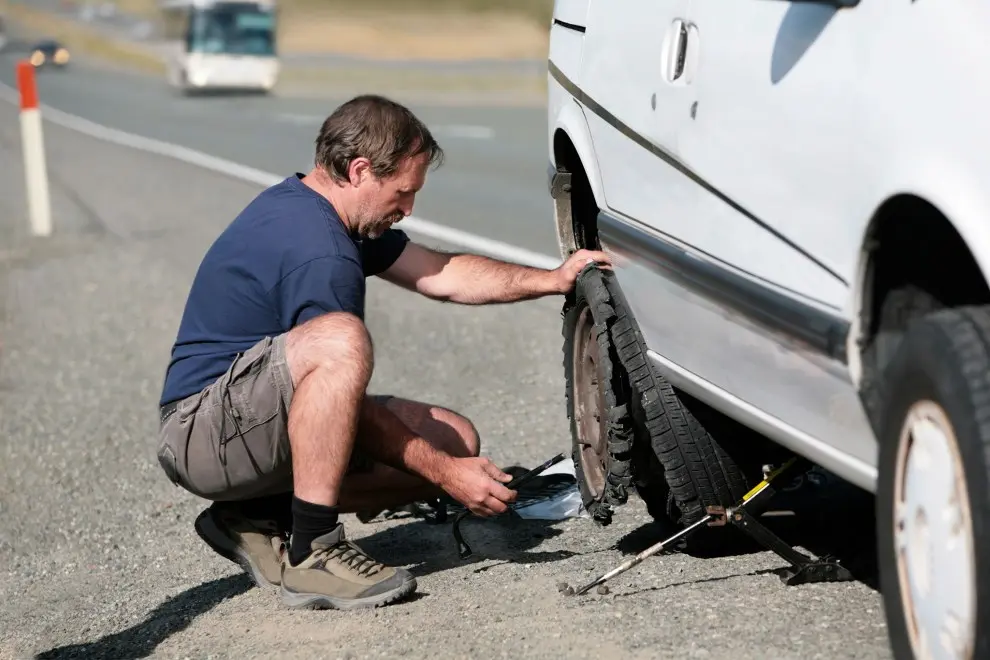
Driving on bald tyres is illegal across the UK. Under UK traffic regulations, the minimum legal tyre tread depth for passenger cars and light commercial vans is 1.6 millimetres across the central three-quarters of the tyre tread width, around the entire circumference.
Worn tyres severely limit wet grip, lengthen stopping distances, and risk heavy fines and licence penalty points. This guide from Tyres & Tyres Ltd explains UK legal rules, penalties, three reliable checks to perform at home, and why replacing tyres before the legal minimum is essential on wet London roads.
What the Law Actually Says
Under the Road Vehicles (Construction and Use) Regulations, cars, light vans up to 3,500 kg, and light trailers must maintain at least 1.6 mm of tread across a continuous band covering the central three-quarters of the tread width, around the entire outer circumference.
The "central three-quarters" refers to the middle 75% of the tread width between shoulders. The outer eighth on each side is excluded from the 1.6 mm rule, but the middle 75% must have at least 1.6 mm of groove depth continuously around the full 360-degree circumference without bald spots.
Tyres must also remain free from structural defects like deep cuts, lumps, bulges, tears, or exposed cords. A tyre with 4 mm of tread is still completely illegal if an inner cord or sidewall bulge is visible.
Penalties for Bald or Worn Tyres in the UK
Tyre offences in the UK are enforced per tyre by police forces and DVSA examiners:
- Penalty points: Up to 3 penalty points per illegal tyre. Four defective tyres equals 12 points in a single traffic stop, risking an automatic court summons and potential driving ban.
- Fines: Defective tyres carry substantial fines per tyre. Check current penalties on GOV.UK (search for 'tyre tread').
- Insurance invalidation: Driving on illegal tyres can invalidate your motor insurance policy. If an accident occurs, insurers may deem the vehicle unroadworthy, potentially declining claims and leaving you personally liable for damages.
How to Check Your Tyre Tread Depth
Checking tread depth takes only a few minutes with three simple methods:
Method 1: The 20p Coin Test
The 20p test is the quickest roadside check. Insert a 20p coin upright into the main tread grooves and look at the outer rim from eye level. If the raised outer band remains hidden in the groove, tread depth is above the 1.6 mm legal limit. If any part of the outer band stands proud above the groove, your tyre is likely on or below the legal minimum and needs urgent attention. Repeat this check across the central three-quarters and at several spots around the tyre.
Method 2: Tyre Wear Indicator Bars (TWI)
Modern tyres feature Tread Wear Indicators (TWIs) moulded into groove bases. Locate the 'TWI' letters, triangle mark, or manufacturer logo on the sidewall shoulder, then trace into the groove. Raised rubber cross-bars sit exactly 1.6 mm high. If tread has worn flush with these cross-bars, the tyre has reached the legal limit and must be replaced immediately.
Method 3: Dedicated Tread Depth Gauge
A depth gauge provides the most accurate measurement. Push the measuring probe into the lowest point of the groove until the base sits flush on the tread block, then read the depth in millimetres. Digital gauges read to 0.1 mm, helping you spot uneven wear early.
Check the Whole Tyre, Not Just One Spot
Inspecting only the outer tread edge from a standing position is a common mistake. Steering geometry and tracking faults often cause tyres to wear heavily on the inner shoulder, which cannot be seen from above.
To check thoroughly: park on a level surface, apply the handbrake, and turn the steering wheel onto full lock to expose the inner tread. Inspect the outer shoulder, central grooves, and inner shoulder. Roll the vehicle forward half a wheel turn to check the section previously resting on the tarmac. Finally, inspect all four tyres plus your spare wheel, as a worn spare cannot help in an emergency.
Uneven wear patterns reveal mechanical issues: wear on both outer edges indicates under-inflation; centre wear indicates over-inflation; and heavy wear on one edge indicates tracking misalignment or worn suspension bushes.
When to Replace Before 1.6 mm
Remember that 1.6 mm is the legal bare minimum—the point where driving becomes illegal—not a safe operating recommendation.
Braking tests prove that wet grip deteriorates well before tyres reach 1.6 mm. A new tyre begins with roughly 7 mm to 8 mm of tread pattern. At 3 mm, water clearance is already substantially reduced. Between 3 mm and the legal 1.6 mm limit, wet stopping distances from 60 mph increase significantly—often by several car lengths in an emergency stop. Most safety bodies recommend replacing tyres once they reach 3 mm, especially ahead of wet autumn and winter months.
Winter and Wet London Roads
London driving involves frequent rainfall, surface standing water, and congested commuter routes. Key corridors such as the A40 Western Avenue, A406 North Circular, M4, and M25 frequently suffer from standing water during heavy downpours.
Tyre grooves pump surface water away from the contact patch. At 1.6 mm, shallow grooves choke easily, trapping water beneath the tyre. This causes aquaplaning, where tyres lose contact with the tarmac and the vehicle slides uncontrollably. Maintaining 3 mm or more provides a vital safety margin on fast London corridors.
What to Do If Your Tyres Are Close to or Below the Limit
If any tyre is close to or below 1.6 mm, do not continue driving on it. Driving an unroadworthy car to a tyre shop still constitutes driving on public roads.
Instead, call Tyres & Tyres Ltd. Dispatched from our Park Royal base at 189C Brent Crescent, London NW10 7XR, our mobile vans come straight to your home driveway or workplace across West and North West London. We replace and digitally balance fresh tyres on site, fit new valves, and dispose of old casings cleanly—so you never have to drive on unsafe rubber.
Does Tread Depth Affect the MOT?
Tyre condition is a leading cause of UK MOT failures. During the test, tread depth below 1.6 mm across the central three-quarters is classified as a Major or Dangerous defect, causing an immediate fail. Exposed cords or ply fabrics are categorised as Dangerous, meaning the vehicle cannot legally be driven away from the test centre. Severe uneven wear or sidewall bulges also trigger an automatic failure.
Checking your tread depth with a gauge or 20p coin before your test allows you to replace worn tyres beforehand and avoid re-test delays.
Need New Tyres Fitted at Home or Work?
If your tread is close to the 1.6 mm limit, avoid driving on unsafe rubber. We fit brand new tyres at your location across West and North West London.
Frequently Asked Questions
What is the legal tyre tread depth in the UK?
The legal minimum tyre tread depth in the UK for cars and light commercial vans is 1.6 millimetres across the central three-quarters of the tyre tread width, around the entire circumference of the tyre.
Can you fail an MOT for tyre tread depth?
Yes. Any tyre with tread depth below the 1.6 mm legal limit across the central three-quarters will cause an immediate MOT test failure as a Major or Dangerous defect.
How often should I check my tyre tread depth?
We recommend checking your tyre tread depth at least once every month, and always before setting off on long motorway journeys or ahead of winter weather.
Can I drive to a tyre shop on illegal tyres?
No. Driving on public roads with tyres below 1.6 mm is illegal regardless of your destination. The safest option is to use a mobile tyre fitting service that replaces your tyres at your home or workplace.