
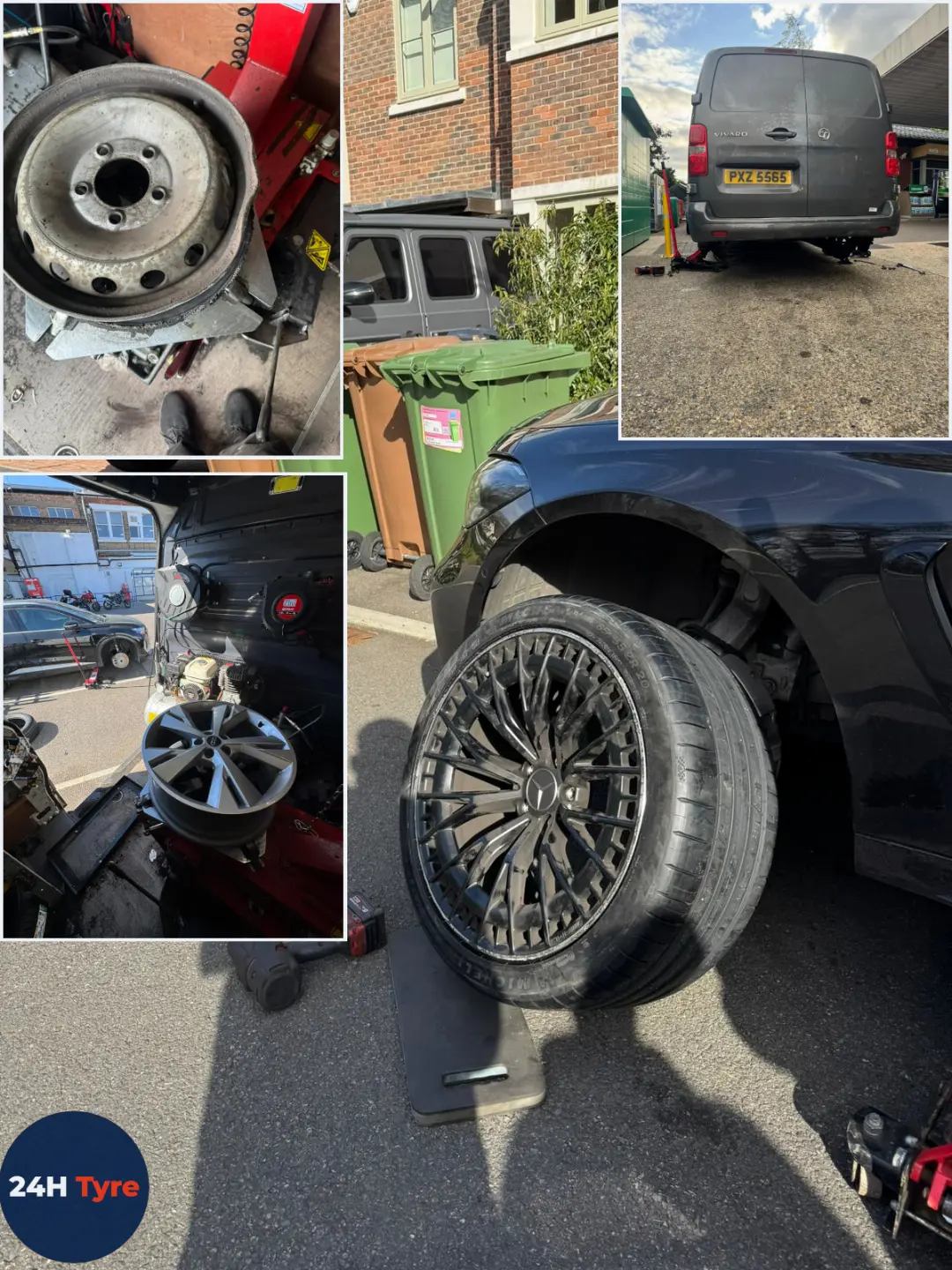
Quick takeaway: Run-flat tyres feature reinforced sidewalls that allow you to continue driving for a limited distance at reduced speed after a complete loss of air pressure. Normal tyres deliver a noticeably softer ride, carry lower replacement costs, and can often be repaired following minor punctures. You must never mix run-flats and standard tyres on the same axle, and punctured run-flats almost always require full replacement.
When purchasing replacement tyres or ordering emergency mobile tyre fitting across London, one of the most frequent questions motorists ask is whether their vehicle needs run-flat tyres or standard normal tyres. While many modern premium vehicles—particularly models from BMW, Mercedes-Benz, and MINI—come equipped from the factory with run-flats, other car owners wonder whether switching between the two tyre types is safe or legal.
Understanding the fundamental differences in construction, ride comfort, puncture behaviour, and roadside safety will help you make the right choice for your car, your driving habits, and your budget.
How Run-Flat Tyres Work
The vast majority of modern run-flat tyres employ a self-supporting sidewall design. Under normal operating conditions, compressed air carries the vehicle's weight, just like any conventional tyre. However, if a screw, nail, or sharp road debris punctures the tread, the air escapes rapidly.
On a normal tyre, losing air pressure causes the tyre to deflate completely. The rim drops directly onto the collapsed rubber, causing the tyre bead to detach, shredding the sidewall, and making steering control impossible within seconds.
On a run-flat tyre, thick inserts of specialized heat-resistant rubber inside the sidewalls maintain structural rigidity even at zero pressure. The reinforced sidewalls bear the full weight of the vehicle, preventing the wheel rim from contacting the asphalt and keeping the tyre firmly seated on the bead. This allows the motorist to retain full steering and braking control, avoiding an emergency stop on a live motorway lane or dangerous urban junction.
| Feature / Aspect | Run-Flat Tyres | Normal (Standard) Tyres |
|---|---|---|
| Handling Punctures | Reinforced sidewalls stay upright at zero pressure; drive a limited distance at reduced speed to safety. | Deflates completely; car must be brought to an immediate stop to avoid rim damage and loss of control. |
| Spare Wheel Requirement | No spare wheel or roadside jack needed; frees up boot capacity and lowers vehicle payload. | Requires a spare wheel, a space-saver, or a temporary roadside tyre sealant inflation kit. |
| Ride Comfort & Noise | Stiffer sidewalls transmit more bumps and road imperfections into the vehicle cabin. | Softer, flexible sidewalls provide superior shock absorption, smoother cruising, and lower road noise. |
| Repairability | Very rarely repairable; zero-pressure driving stresses internal cords invisibly, mandating replacement. | Frequently repairable under British Standard BS AU 159 if the puncture is within the central tread area. |
| Typical Cost | Higher initial purchase cost due to specialized reinforced rubber compounds and construction. | Lower initial purchase cost with greater availability across standard tyre retail networks. |
| Best Suited For | Motorway commuters, late-night drivers, and vehicles manufactured without spare wheel wells. | Drivers seeking maximum ride comfort, lower running costs, and readily repairable puncture solutions. |
Pros and Cons of Run-Flat Tyres
Run-flat tyres offer distinct practical advantages, but they also involve definite trade-offs that every driver should evaluate before deciding on replacements.
Advantages of Run-Flats
- Continuous Roadside Safety: If you suffer a puncture on a crowded dual carriageway, in roadworks, or on a smart motorway without a hard shoulder, you do not have to pull over into live traffic. You can safely continue driving to the nearest exit or service area.
- No Dangerous Roadside Wheel Changes: Changing a wheel beside fast-moving traffic is one of the most hazardous roadside scenarios. Run-flats eliminate the need to jack up the car in the rain or dark.
- Maximised Boot Space: Because vehicle manufacturers do not need to provide a spare wheel, jack, or wheel brace, the boot floor is lower and more luggage space is available.
- Preserved Vehicle Stability: If a puncture occurs at higher speeds, the rigid sidewall prevents the violent pulling and sudden yaw that can cause a vehicle on normal tyres to skid.
Disadvantages of Run-Flats
- Firmer Ride Quality: To support a vehicle weighing over a tonne without air, the sidewalls must be exceptionally rigid. On uneven city streets and potholed urban surfaces, this translates to a stiffer ride.
- Higher Replacement Expense: Due to specialized construction materials, run-flats generally carry a premium over equivalent standard tyres.
- Limited Repair Options: When driven deflated, internal structural heat builds up inside the sidewall plies. Because this internal damage cannot be safely verified by visual inspection, most tyre manufacturers strictly prohibit puncture repairs.
Pros and Cons of Normal Tyres
Standard pneumatic tyres remain the industry benchmark across the vast majority of cars in the UK for solid engineering reasons.
Advantages of Normal Tyres
- Superior Road Comfort: Flexible sidewalls act as secondary suspension dampers, soaking up road vibrations, cobbles, expansion joints, and minor potholes before they reach the cabin.
- Lower Ongoing Costs: Normal tyres are less expensive to buy across all dimensions, saving motorists money when replacing pairs or complete sets.
- Standard Puncture Repairability: When a standard tyre incurs a nail in the central tread band, a professional technician can dismount it, inspect the interior lining, and perform a durable British Standard vulcanised combi-plug repair.
- Wider Stock Availability: Standard tyres are manufactured in far greater variety across budget, mid-range, and premium tiers, making same-day sourcing straightforward.
Disadvantages of Normal Tyres
- Immediate Immobility: A severe puncture forces you to stop immediately wherever you are, often leaving you stranded in inconvenient or dangerous roadside locations.
- Reliance on Spares or Sealants: You must have a functional spare wheel, or carry an aerosol tyre sealant canister and compressor kit—neither of which works if the tyre suffer a blowout or sidewall split.
Four Critical Rules Every Driver Must Know
Rule 1: Never Mix Run-Flat and Normal Tyres on the Same Axle
You must never fit a run-flat tyre on one side of an axle and a standard tyre on the other. Because the sidewall stiffness, flexing characteristics, and grip thresholds differ dramatically between the two constructions, mixing them creates severe handling imbalances. Under heavy braking or sudden evasive manoeuvres, the car will pull unpredictably. This configuration will fail an MOT test and compromises vehicle stability systems.
Rule 2: Can You Switch from Run-Flats to Normal Tyres?
Yes, you can legally change a car that came with factory run-flats to standard tyres, but you must observe specific criteria:
- Replace all four tyres together: To ensure uniform chassis balance, predictable handling, and correct electronic stability control (ESC) calibration, replace all four tyres as a complete set.
- Ensure TPMS remains active: Your vehicle must continue monitoring tyre pressure accurately via its dashboard tyre pressure monitoring system.
- Carry alternative breakdown provisions: Because your vehicle does not have a spare wheel well, you must carry a suitable tyre sealant inflator kit or ensure you have access to 24/7 mobile assistance.
- Check insurance and manufacturer guidance: Some vehicle insurers and warranty providers classify tyre specification changes as a modification. Always inform your insurer before making the change.
Rule 3: Can You Put Run-Flats on a Car Not Designed for Them?
Fitting run-flat tyres to a car originally engineered for normal tyres is generally not recommended. First, run-flats legally require a fully functioning Tyre Pressure Monitoring System (TPMS). Because run-flat sidewalls do not sag visibly when deflated, a driver without TPMS could drive unaware at high motorway speeds on zero pressure, causing eventual tyre failure. Second, suspension dampers and bushings designed for flexible normal tyres will feel excessively harsh when paired with ultra-stiff run-flat sidewalls.
Rule 4: Can a Punctured Run-Flat Tyre Be Repaired?
Under British Standard BS AU 159 and the official guidelines of major tyre manufacturers, punctured run-flat tyres are almost always non-repairable. When a run-flat tyre is driven on while deflated, the vehicle weight generates intense friction and heat inside the rubber compound of the sidewall. Even if the outer tyre appears undamaged, the internal reinforcement cords may have fractured. Repairing the tread does not restore sidewall structural integrity. For safe motoring, replacement is required. When you need replacement at home or roadside, our mobile vans provide dedicated run-flat tyre fitting across London 24 hours a day.
Need Run-Flat Tyre Replacement in London?
Whether you need fresh run-flat tyres fitted at your home driveway or emergency replacement at the roadside, our mobile tyre technicians operate around the clock from our Park Royal NW10 hub.
Frequently Asked Questions
How do I know if my car currently has run-flat tyres?
Examine the embossed lettering on the tyre sidewall. Manufacturers use specific codes: Continental marks them SSR, BMW-approved tyres carry a star symbol alongside RSC, Pirelli uses Run Flat or r-f, Michelin uses ZP (Zero Pressure), Bridgestone marks RFT, and Goodyear uses ROF or EMT. Additionally, if your vehicle was supplied without a spare wheel well or roadside jack, it was likely factory-delivered with run-flats.
Can I replace just one punctured run-flat tyre with a normal tyre?
No. Mixing a normal tyre with a run-flat tyre across the same axle is dangerous and illegal for UK road safety standards. The difference in sidewall stiffness causes severe handling instability under emergency braking and will trigger ABS and traction control errors.
Why does my car feel firmer when driving on run-flat tyres?
Run-flat tyres require thick, reinforced rubber sidewalls to support the entire vehicle weight when air pressure is lost. Because these sidewalls have far less vertical elasticity than normal tyres, more road texture, potholes, and surface irregularities are transferred directly through the vehicle chassis.
Do run-flat tyres require specialized tyre fitting equipment?
Yes. Because the sidewalls are exceptionally stiff and rigid, mounting and demounting run-flat tyres requires high-torque fitting machines equipped with robotic assist arms and plastic rim protectors. Attempting to fit run-flats with standard manual levers can tear the tyre bead or permanently gouge expensive alloy wheels.